Faster Tax Savings for Smarter AI Investment
Canada’s Productivity Mega Deduction gives business leaders another reason to examine their next technology investment. But the most useful question comes before the purchase: what will this investment help your people accomplish?
The CBC report’s[3] $120,000 example makes the tax mechanism easier to understand. An eligible investment can generate its tax deduction sooner, leaving more cash available in the early years. Turning that investment into better service, stronger sales or more efficient operations requires a separate business decision.
For organizations considering artificial intelligence, both questions matter: how will the investment affect cash flow, and how will it improve the work?
What is the Productivity Mega Deduction?
The federal proposal would permanently allow immediate expensing for a broad range of eligible depreciable property acquired on or after September 15, 2026. The deduction would generally be claimed in the year the property becomes available for use, subject to the applicable conditions and exclusions. [1]
Instead of deducting an eligible asset’s cost gradually through capital cost allowance, a business could deduct the full eligible cost sooner.
The Mega Deduction builds on the Productivity Super-Deduction announced in Budget 2025. The earlier name appears in the CBC screenshots alongside the newer measure. Budget 2026 confirms the government’s intention to proceed with the September 2026 legislative and regulatory proposals. These announcements should be distinguished from confirmation of enacted rules and their application to a particular purchase. [1][2]
The $120000 example - what actually changes
The screenshots supplied from CBC’s report[3] compare a $120,000 investment under a simplified 30% declining-balance deduction with immediate expensing.
The displayed savings imply a tax rate of 11.2%:
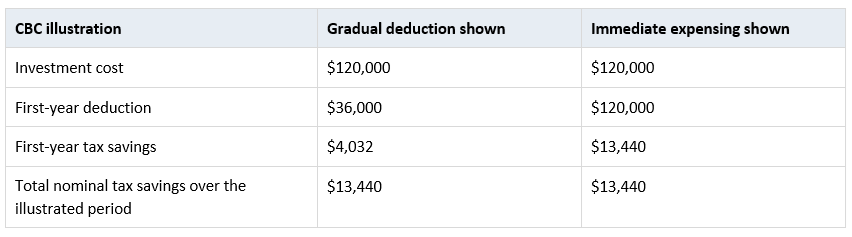
$13,440 ÷ $120,000 = 11.2%.
Under those assumptions, immediate expensing leaves the business with $9,408 more cash in the first year compared with the gradual deduction shown:
$13,440 − $4,032 = $9,408.
The example’s central lesson is timing. The same total nominal tax savings arrive sooner, assuming the full cost is eventually deducted at an unchanged tax rate. Money retained earlier can support working capital, reduce financing needs or fund the next stage of implementation.
A deduction reduces taxable income. The resulting tax savings depend on the applicable tax rate and the ability to use the deduction.
The CBC figures are a teaching example. The inferred 11.2% rate is not a default rate for Québec businesses, and the 30% schedule is not a universal depreciation rule. Actual results depend on asset classification, available deductions, taxable income, provincial treatment and other circumstances. The table also does not model a later sale or potential recapture.
Why this matters for AI and CRM projects
Earlier tax savings can strengthen the financing of a qualifying investment. Measurable operational improvements make the investment worthwhile.
For a service team, a valuable AI opportunity might be reducing the time employees spend preparing case summaries. For sales, it might be improving account research or follow-up. For operations, it might be reducing repeated data entry between systems.
A useful starting point is specific:
We want to reduce the time needed to prepare a customer case summary while maintaining accuracy and keeping employees responsible for approval.
This defines the work, the desired result and the human responsibility. It also gives a Salesforce or Agentforce pilot something meaningful to test.
Buying technology alone does not establish productivity. The organization needs reliable data, a workable process, trained employees and someone accountable for the outcome.
Keep three parts of the business case visibleKeep three parts of the business case visible
An AI investment assessment should show three separate views:
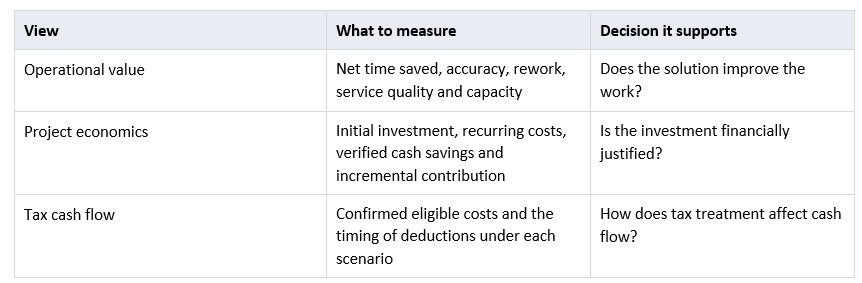
Separating these views makes the assumptions easier to challenge and prevents benefits from being counted twice (double-counting).
For example, salary-equivalent time savings can represent valuable capacity even when payroll remains unchanged. Similarly, the full tax reduction from immediate expensing is not automatically an additional benefit over ordinary treatment: the comparison must account for deductions the business would otherwise receive later.
What could three minutes be worth
Consider a service organization handling 100,000 service requests annually.
Suppose a controlled pilot demonstrates three minutes saved per interaction, after allowing for new review and correction work. Assume the improvement reaches 70% of interactions and 80% of the released time becomes usable capacity.
100,000 × 3 ÷ 60 × 70% × 80% = 2,800 usable hours annually.
At an assumed fully loaded labour cost of $45 per hour, this represents $126,000 in annual capacity value.
The team could use that capacity to absorb growth, reduce backlogs or improve customer service. It becomes a cash saving when spending actually falls or an otherwise necessary cost is avoided.
If recurring AI costs are $50,000 annually, the illustrative capacity value after those costs is $76,000, before initial implementation costs and other adjustments. A cash ROI calculation should use documented cash benefits rather than automatically treating all $126,000 as savings.
Tax treatment can then be assessed alongside this operational case using the actual eligible expenditures and an appropriate comparison schedule.
Does every AI project expense qualify ?
An AI project may include computers, acquired software, cloud subscriptions, usage charges, integration, consulting and training. These expenditures can receive different tax treatment.
Do not apply a blanket Mega Deduction percentage to the entire Salesforce or Agentforce project budget. Some expenditures may already receive ordinary expense deductions; others may be capitalized or subject to different rules.
Ask your accountant to review each cost category, confirm federal and Québec treatment, and establish the acquisition and available-for-use dates. Tax-exempt organizations may still have a strong productivity case without a direct income-tax saving.
Start with readiness then prove the result
Before choosing a platform or expanding an existing deployment, assess five practical areas:
Business value: Which recurring problem is worth solving?
Process: Is the workflow understood, including exceptions and escalation?
Data: Is the information reliable, accessible and appropriately protected?
People: Will employees know how to use the solution and when to intervene?
Governance: Who approves access, monitors quality and owns the result?
Choose one workflow with a clear baseline and an accountable owner. Set success criteria for time, accuracy, rework and customer outcomes. Run a limited pilot, then use the evidence to decide whether to expand, revise or stop.
The Mega Deduction may improve the timing of qualifying investment costs. Your readiness work determines whether that investment can produce useful results.
Ready to identify your first practical AI opportunity?
Start the CRM Agile AI Readiness Assessment to explore your organization’s readiness and the questions to resolve before investing. You can reach me here.
General information based on federal proposal and budget materials reviewed November 17, 2026 [3] . The CBC calculations are reproduced as a simplified illustration from screenshots supplied for this article. Confirm enacted rules, eligibility and your organization’s tax treatment with a qualified tax adviser.